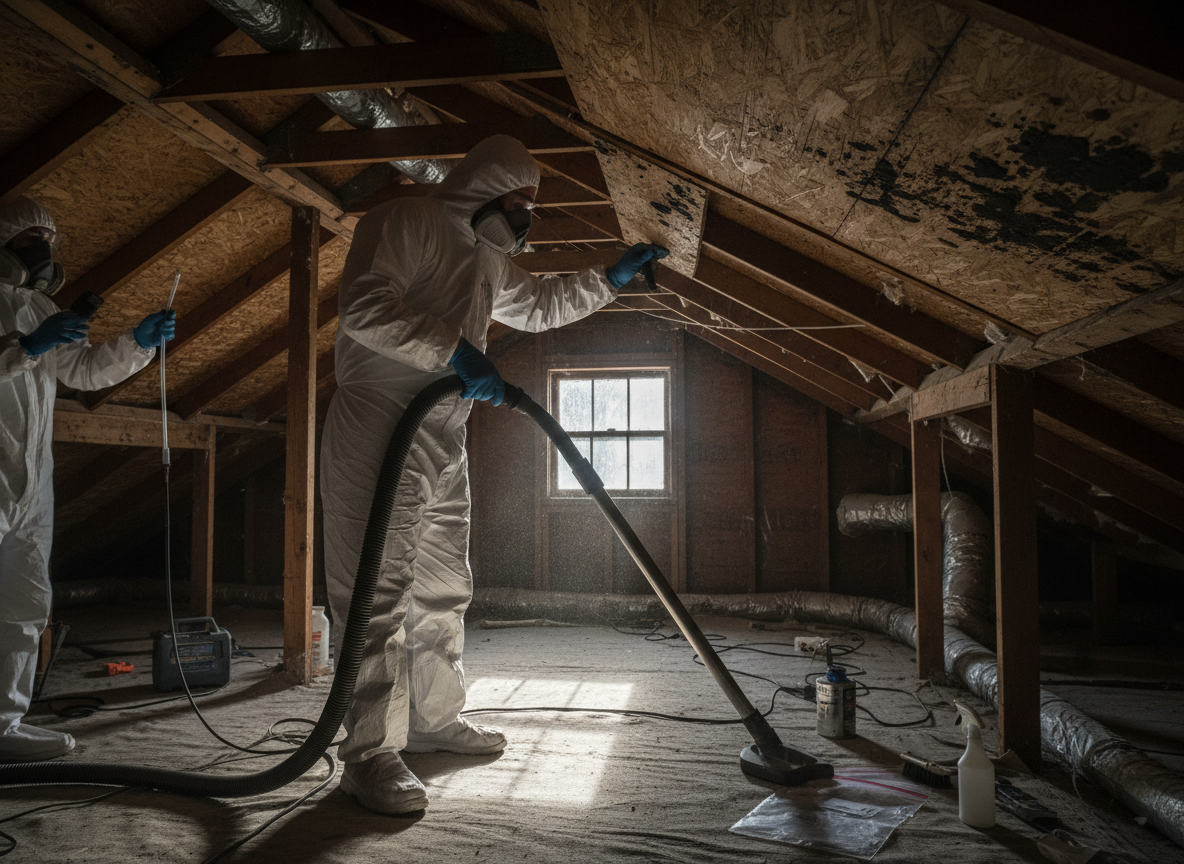
Bryn Mawr attics in homes from the 1950s and 1960s often hold fiberglass batts laid directly on ceiling joists under clay tile roofs. When rare winter rains find their way past aging flashing around vents or chimneys, moisture sits against the paper facing and feeds Aspergillus or Penicillium colonies that later release spores into living spaces below. Testing starts with moisture metering of sheathing and joists plus tape-lift samples sent to a lab rather than relying on visual inspection alone because black staining on rafters can be old soot from the 2003 fires instead of active mold.
Removal requires full containment with 6-mil poly sealed at the attic hatch and negative air machines exhausting through a window to avoid cross-contaminating the rest of the house. We cut out only the wet insulation, HEPA-vacuum exposed wood, and apply an antimicrobial that leaves no residue because many Bryn Mawr residents store holiday decorations and clothing in the same space. Post-remediation air samples confirm clearance before any new insulation goes back in, and we document every step for insurance adjusters who frequently handle claims along Juanita Street and nearby blocks east of the 215 freeway.
Edge cases include knob-and-tube wiring that must stay untouched during wet wipe-downs and stucco homes where exterior wall leaks travel upward into the attic through balloon framing. We also check for rodent droppings that can mask or worsen mold odors in crawlspaces connected to the same vent stacks.
Technician insight
In Bryn Mawr, the thing that catches most people out with Attic mold testing and removal is how our dry summers let small roof leaks around plumbing vents go unnoticed for years until a single winter storm soaks the fiberglass batts in 1950s tract homes along Juanita Street.
Musty Odor After Winter Rain
A Bryn Mawr homeowner called after noticing a musty smell in bedrooms following December rains. We found active growth on insulation where flashing had failed around a bathroom vent on a 1962 home. Containment was set, wet material removed, and wood treated. Clearance samples passed and the odor disappeared.
How it works
- 1
Initial Assessment
Walk the attic with moisture meters and borescopes while noting roof leaks common after Santa Ana winds damage flashing on older tile roofs in Bryn Mawr.
- 2
Sampling and Lab Analysis
Collect air and surface samples for third-party lab confirmation before any disturbance begins.
- 3
Containment and Removal
Set up sealed poly barriers and negative air, then remove affected insulation and clean wood members.
- 4
Clearance Testing and Documentation
Run post-remediation samples and provide a written report for homeowners and insurers.
Pricing
Pricing varies with attic size, access difficulty, and extent of insulation removal required; we provide upfront quotes after the initial assessment.